
Why European Businesses Need a Different AI Visibility Strategy (And What US Agencies Won't Tell You)
By Andreas Höfelmeyer
Certified AI Search Architect & Senior Data Analyst
Your prospects are asking ChatGPT for recommendations right now. Not Google. Not your LinkedIn profile. They are typing questions like "best supply chain consultant in Germany" or "top engineering firm in Barcelona" into AI assistants and trusting the answers.
Here is the uncomfortable truth: if you are a European business owner, the standard advice on how to show up in those answers was written for the American market. It does not account for your reality. And following it blindly could cost you months of wasted effort.
This article explains exactly why European businesses face a fundamentally different AI visibility challenge and what to do about it.
The Shift Has Already Happened
The numbers make the urgency clear. A 2025 6sense study of nearly 4,000 B2B buyers found that 94% used AI tools during their purchasing process. Forrester's Buyers' Journey Survey (n=18,000) confirmed 89% of B2B buyers have adopted generative AI for research. And according to research from Responsive, one in four B2B buyers now use generative AI more often than conventional search when researching suppliers.
Meanwhile, G2's 2025 Buyer Behavior Report found that AI chatbots have become the number one source influencing vendor shortlists at 17.1%, surpassing software review sites (15.1%), vendor websites (12.8%), and salespeople (8.8%).
The pre-contact favorite wins approximately 80% of deals, according to 6sense. Ninety five percent of winning vendors are on the buyer's Day One shortlist. If your business is not in the AI-generated answer when that shortlist forms, you are already out.
But here is what makes this critical for European businesses specifically: DSIT's AI Adoption Research from January 2026 (n=3,500 UK businesses) reveals a staggering gap. Only 16% of UK businesses currently use at least one AI technology. Yet 89% of their B2B customers are already using it to choose suppliers. The supply side is asleep while the demand side has moved on.
The Language Problem Nobody Is Talking About
Most AI visibility guides assume your business operates in English, in a single market. For European businesses, this assumption breaks everything.
Weglot conducted the largest study on multilingual AI citations ever published, analyzing over 1.3 million citations across Google AI Overviews and ChatGPT. Their finding: untranslated websites lose up to 431% of their visibility when users search in a language the site does not support. Even when these businesses rank well in their primary language, AI platforms functionally ignore them for queries in other languages.
Why does this matter so much for European businesses? Because your market is multilingual by default. A management consultancy in Milan serves clients who search in Italian, English, and German. A logistics firm in Rotterdam needs visibility in Dutch, English, and French. A tech startup in Barcelona operates across Spanish, Catalan, English, and potentially Portuguese markets.
The Weglot study found that translated sites receive 327% more citations than untranslated equivalents. And here is a detail that changes the equation entirely: ChatGPT uses a dual-query approach for non-English users. When someone asks a question in Spanish, ChatGPT searches the web twice, once in English and once in Spanish. If your site only exists in one language, you are invisible to one of those two searches every single time.
For translated sites, ChatGPT showed virtually no language bias. Spanish sites actually received 0.3% more citations in English than in Spanish. Translation does not just help. It eliminates the disadvantage entirely.
No US-focused LLMO guide will tell you this because the problem does not exist for them.
Entity Disambiguation: The European Complexity Multiplier
AI systems do not read your website like a human does. They try to identify entities: specific, uniquely identifiable "things" in their knowledge graph. Your business, your founder, your services, your location. Each of these is an entity that needs to be unambiguously recognized.
For American businesses, this is relatively straightforward. One country, one primary language, one legal framework.
For European businesses, entity disambiguation becomes exponentially harder. Consider a founder named "Andreas Müller" operating an engineering firm in Zürich. AI systems need to distinguish this specific person and this specific firm from every other "Andreas Müller" and every other engineering company in the German-speaking world. Without explicit structured data and cross-platform entity linking, the AI will either confuse you with someone else, merge your information with a different entity, or simply skip you because the signal is too weak.
This is compounded by Europe's fragmented business registry systems. In the US, a business registers in one state and that information propagates through a relatively unified system. In Europe, you might be registered in the Spanish Registro Mercantil, listed in a German Handelsregister, and referenced in an Italian Camera di Commercio database, each with slightly different name formats and data structures. AI platforms struggle to connect these fragments into a single, coherent entity.
The technical solution is what I call the "Source of Truth Triad": your website, your LinkedIn presence, and your knowledge graph must be architecturally aligned. Schema.org markup with stable @id values, sameAs links to your profiles across platforms, and consistent entity definitions across every digital touchpoint.
This is not optional for European businesses. It is the foundation everything else builds on.
GDPR Changes the Playbook
Every US-focused LLMO strategy leans heavily on third-party data signals: reviews on Yelp, mentions on Reddit, citations in niche directories. These platforms scrape, aggregate, and cross-reference data freely. American businesses benefit from this data ecosystem without lifting a finger.
European businesses operate under the General Data Protection Regulation, which fundamentally alters how data flows through the ecosystem that AI platforms depend on. GDPR's restrictions on personal data processing, the right to erasure, and strict consent requirements mean that the European web is structurally different from the American web.
The practical impact: many European business directories and review platforms contain less data than their US equivalents. European professionals are more cautious about public reviews. Corporate websites often contain less structured personal information. All of this reduces the signals available for AI platforms to build confidence about your entity.
This is not a problem to solve. It is a constraint to work within. And it demands a strategy that generates stronger first-party signals (your website, your schema markup, your directly controlled profiles) to compensate for the thinner third-party signal environment.
The European Data Protection Board's Opinion 28/2024 provides additional context. Organizations relying on legitimate interest for AI-related data processing must conduct thorough three-step balancing tests. For European businesses building AI visibility, this means your own structured data layer becomes your most valuable asset. You control it, you own it, and GDPR cannot diminish it.
The EU AI Act Factor
While most LLMO advice ignores regulation entirely, European businesses cannot afford to. The EU AI Act, which took effect in 2024 with enforcement tightening through 2026, creates compliance requirements for AI systems operating in the European market.
For businesses optimizing their AI visibility, this creates both a challenge and an opportunity. The challenge: platforms operating in Europe may adjust their citation behavior to comply with transparency requirements, potentially changing how and when they recommend businesses. The opportunity: businesses that structure their digital presence with clean, verifiable, GDPR-compliant data are exactly the kind of "trustworthy source" that AI platforms prefer. Compliance becomes a competitive advantage.
This regulatory layer simply does not exist in the US market. Any AI visibility strategy imported from across the Atlantic ignores it completely.
What Actually Works for European Businesses
Based on auditing dozens of European business websites for AI visibility, here is what moves the needle:
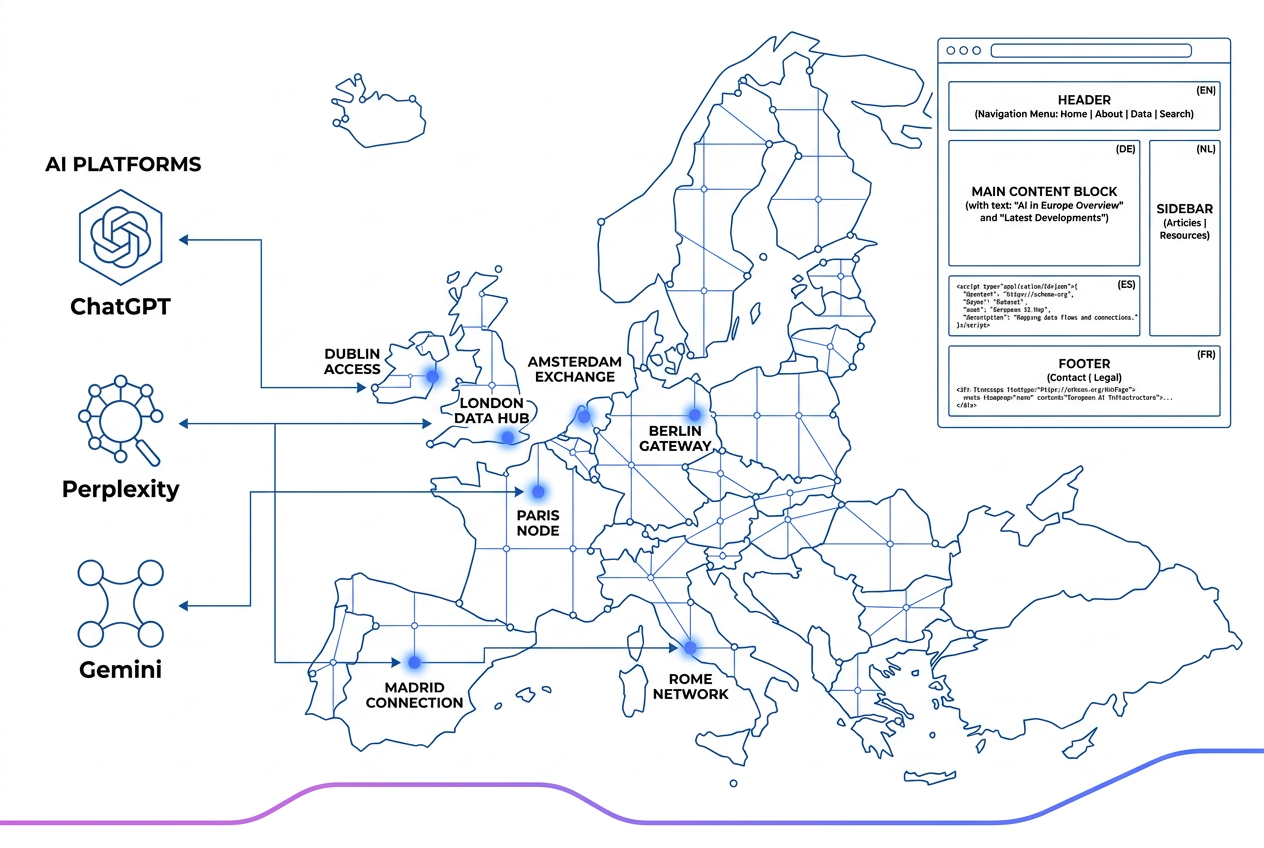
Build a multilingual structured data layer first. Before writing a single blog post, implement comprehensive Schema.org markup on your site in every language you serve. Organization schema, Person schema for key team members, Service schema for your offerings, and FAQ schema for the questions your prospects ask. Each language version needs its own entity definition with proper hreflang and sameAs linking.
Treat translation as a visibility multiplier, not a convenience feature. The Weglot data is unambiguous. Translation delivers a 327% citation boost. For a European business targeting even two markets, this is the single highest-ROI action available. But it must be proper localized translation with language-specific schema markup, not just machine-translated text.
Strengthen first-party signals to compensate for thinner third-party ecosystems. Publish original research. Include statistics, case studies, and verifiable claims on your website. Studies show that content containing statistics increases AI citations by 22%, while content with quotations boosts visibility by 37%. Your site needs to be so authoritative that AI platforms cite it directly, rather than relying on directory listings.
Create an llms.txt file. This is a machine-readable summary of your business that AI crawlers can consume instantly. It is the equivalent of a robots.txt but designed for language models. Less than 4% of websites currently have one. For European businesses competing in fragmented, multilingual markets, this small file punches far above its weight.
Bridge your Knowledge Graph entity to your website. Verify your Google Business Profile, connect it to your website through the CID link in schema markup's hasMap property, and build sameAs connections to every platform where your entity exists. AI platforms look for verified entities in the Knowledge Graph, not just web pages with keywords.
The Window Is Open, But Closing
Profound's analysis of 680 million AI citations found only approximately 11% domain overlap between ChatGPT and Perplexity. Each platform has a distinct citation personality, and a brand optimizing for only one will be invisible on the others. For European businesses operating across multiple markets and languages, this fragmentation creates both complexity and opportunity.
The businesses that build proper entity architecture, multilingual structured data, and GDPR-native digital footprints now will compound their advantage. Every new piece of content inherits the organizational authority. Every new market entry benefits from the existing entity clarity. Those that wait will find themselves competing against entrenched competitors whose AI visibility grows stronger every month.
The standard playbook was not built for you. Build the one that was.
Andreas Höfelmeyer is the founder of AI-fy.me, Europe's specialist LLMO consultancy. He helps European founders translate their offline reputation into the digital authority that AI platforms recommend.
Ready to see exactly how visible your business is to AI right now?
Take the AI Visibility Roadmap →
Frequently Asked Questions
What is LLMO and how is it different from SEO?
LLMO stands for Large Language Model Optimization. Where SEO focuses on ranking your website higher on Google's list of links, LLMO focuses on getting your business recommended as a direct answer inside AI tools like ChatGPT, Perplexity, and Google's AI Overviews. SEO asks: "How do I appear in search results?" LLMO asks: "How do I become the answer?"
Why can't I just use a US-based LLMO agency for my European business?
US-based approaches assume a single-language market, a data-rich third-party ecosystem, and no GDPR constraints. European businesses operate in multilingual markets where untranslated sites lose up to 431% of their AI visibility. They face entity disambiguation challenges across fragmented national business registries. And they must generate stronger first-party signals to compensate for GDPR's impact on third-party data availability. A strategy built for the US market misses all of these.
How important is website translation for AI visibility?
Critical. Research analyzing 1.3 million citations found that translated sites receive 327% more AI citations than untranslated equivalents. ChatGPT specifically runs dual searches for non-English queries, one in the user's language and one in English. If your site only exists in one language, you are invisible to half of every cross-language search.
Does GDPR make it harder to get recommended by AI?
Not harder, but different. GDPR reduces the volume of third-party data signals available in the European market, which means your own website and structured data become proportionally more important. Businesses that invest in comprehensive Schema.org markup, original content with verifiable claims, and clean entity architecture actually gain a competitive advantage because they produce the strong, trustworthy signals that AI platforms prioritize.
How long does it take to become visible to AI platforms?
Based on real audit data, first mentions typically appear within 2 to 3 weeks of implementing structural changes. Consistent recommendations across multiple AI platforms usually develop by week 8 to 12. Speed depends on your starting point (existing digital footprint), the competitiveness of your niche, and how many languages and markets you target.
What is an llms.txt file and do I need one?
An llms.txt file is a plain text document placed on your website that provides a machine-readable summary of your business for AI crawlers. Think of it as a robots.txt for language models. It helps AI platforms quickly understand who you are, what you do, and why you are an authority. Currently, fewer than 4% of websites have one. Adding it takes minutes and gives AI systems a clear, structured entry point to your business.
Is AI visibility relevant for small or local European businesses?
Absolutely. Research from 6sense shows that even local B2B purchases are increasingly influenced by AI recommendations. A craftsman in Munich, a tax advisor in Madrid, or a design studio in Amsterdam can all benefit from AI visibility because their prospects are already asking AI tools for local recommendations. The entity and structured data work required is the same regardless of business size. What changes is the scope, not the principle.
How do I know if my business is currently visible to AI?
The simplest test: open ChatGPT, Perplexity, and Google's Gemini and ask each one to recommend businesses in your category and location. Ask follow-up questions about your specific company. If the AI has never heard of you, gives incorrect information, or recommends your competitors instead, you have an AI visibility gap. A structured audit can quantify this gap and show exactly what needs to change.

