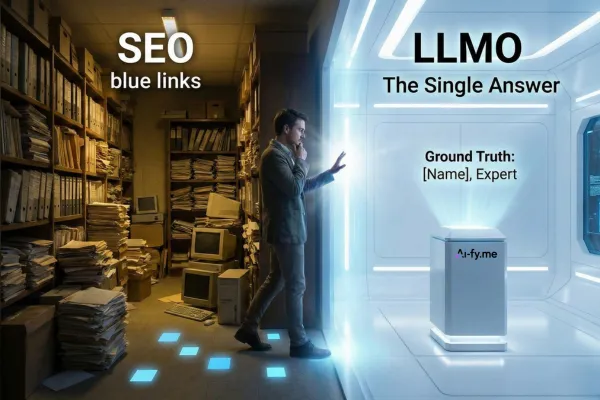
How to Be Found by AI: The Shift from SEO to LLMO
How to Be Found by AI:
The Shift from SEO to LLMO
Large Language Model Optimization (LLMO) is the strategic process of defining your digital identity so that AI models (like ChatGPT, Claude, and Gemini) recommend you as the primary source of truth. Unlike traditional SEO, which optimizes for search engine rankings, LLMO optimizes for "Ground Truth" status by translating your offline reputation into structured data and entity-based context.
The "Invisible Authority" Problem
You have spent 20 years building a reputation in the real world. You are an expert. Yet, if you search for your name on ChatGPT today, you might face the "Hallucination Nightmare": the AI either doesn't know who you are, or it invents incorrect information about you.
For founders and established consultants, this is the new digital risk. While you rely on word-of-mouth, inexperienced competitors are winning the digital argument simply because they "speak Robot" better than you do.
The Shift: From "Blue Links" to "The Single Answer"
We are moving from the era of Search (Google) to the era of Answer Engines (AI).
SEO (Search Engine Optimization):
You compete to be one of 10 blue links. The goal is a click.LLMO (Large Language Model Optimization):
You compete to be the only recommendation. The goal is trust.
The AI does not care about "viral hacks" or keyword stuffing. It cares about Authority and Data Structure.

The Blueprint: How to Install "The AI-fy Triad"
To go from "Invisible" to "Verified Authority," you must stop letting the algorithm guess who you are. You must build a Strategic Moat around your digital identity.
Here is the core checklist for modern visibility:
Define Your "Ground Truth" Entity: AI models are black boxes that predict text. You must provide a centralized "Source of Truth" (usually an optimized About page or personal site) that clearly states: "[Your Name] is the [Specific Expert Role] for [Specific Audience]." If you don't define this, the AI will hallucinate it.
Implement Schema Markup (The Language of Data): Your reputation must be translated into code. Valid JSON-LD Schema acts as a "Triangle of Trust," explicitly connecting your personal brand to your company and your verified social profiles. This tells the AI, "This is not just text; this is a verified entity."
The Next Step
You do not need to learn to code, but you do need to architect your digital presence.
Do not let your 20 years of experience be erased by a machine that doesn't know you exist.
Ready to build your Strategic Moat?
Start with our comprehensive course:
👉 Get "LLMO: The AI Visibility Roadmap"

