Complete Guide to AI Readiness Assessments
Complete Guide to AI Readiness Assessments
AI readiness assessments evaluate strategy, data, infrastructure, people, and governance to prevent 85% of AI project failures by 2025. Organizations conducting them launch initiatives 70% faster. Follow steps: set objectives, score pillars like data quality and leadership, prioritize gaps via heat maps. Pricing starts at €197 for manual audits versus automated tools. Build solid foundations to boost AI success and visibility.
Worried your business is rushing into AI without the right foundation, dooming projects to failure and wasted cash? Most organizations skip readiness checks, and Gartner reports 85% of AI initiatives will fail by 2025 due to gaps in data, skills, or strategy. This complete guide delivers a proven step-by-step framework, best practices, tools, and pricing insights to assess and fix your readiness fast.
Introduction
It is January 2026, and the business world has shifted. We are no longer just asking if AI can write emails; we are asking if AI knows who we are. For consultants and business leaders, the question isn't just about using tools—it's about existence. If a potential client asks ChatGPT or Perplexity for an expert in your field, does it recommend you, or does it hallucinate a competitor?
An AI readiness assessment is your reality check. It moves you past the hype and looks at your actual infrastructure. It tells you if your data is ready to train a model or if your digital footprint is clean enough for an algorithm to trust.
Here is the thing: You cannot build a skyscraper on a swamp. Before you try to implement complex AI solutions or expect AI platforms to recommend you, you need to know if your foundation is solid. This guide breaks down exactly how to check that foundation.
What Is an AI Readiness Assessment?
In simple terms, this assessment is a health check for your organization's ability to handle artificial intelligence. It is not just about having the right software; it is about your data, your people, and your strategy. Many businesses think they are ready because they have a cloud subscription, but that is rarely enough.
You need to know if your data is structured in a way that machines can understand. As noted in recent industry analysis:
"An AI readiness assessment is a systematic evaluation of an organization's preparedness to successfully adopt and implement artificial intelligence technologies. It measures capabilities across strategy, data, infrastructure, people, and governance to identify strengths, gaps, and priorities for AI initiatives." - OvalEdge Blog, How to Measure AI Readiness: Complete Assessment Guide 2026 (OvalEdge Blog)
Why Your Organization Needs an AI Readiness Assessment
You might think you can skip the assessment and just start building. That is a mistake. Without a clear map of where you stand, you risk wasting money on tools you cannot use or, worse, training AI on bad data that damages your reputation.
Speed is a major factor here. Companies that take the time to assess their readiness first actually move faster in the long run because they avoid costly U-turns. In fact, organizations that conduct AI readiness assessments achieve AI initiatives 70% faster than peers (OvalEdge).
Beyond speed, there is the issue of visibility. In 2026, if you do not define who you are, the AI will define you—often incorrectly. An assessment reveals these "hallucinations" before they cost you business.
Can small businesses benefit from AI Readiness Assessments?
Absolutely. There is a misconception that AI readiness is only for Fortune 500 companies with massive data lakes. In reality, small businesses and independent consultants often have the most to lose if they are invisible to AI.
For a smaller entity, readiness is about authority. It is about ensuring that when an Answer Engine (like Gemini or ChatGPT) looks for an expert, it finds your structured, verified data. You don't need a massive team; you need the right guidance.
"AI readiness assessments are performed by highly qualified experts who know exactly what questions to ask, what the answers mean, and how to fill any gaps." - 10Pearls, A Guide To AI Readiness Assessment Frameworks (10Pearls)
How do AI Readiness Assessments evaluate data infrastructure?
This is often the most technical part of the process, but it is critical. An assessment looks under the hood of your data storage and management. It is not enough to just "have" data; it must be retrievable and accurate.
Evaluators typically look for these specific markers:
Discoverability: Is data cataloged so AI agents can find it?
Quality Scores: Is the data at least 80% accurate, complete, and consistent?
Governance: Are there clear rules on who owns the data?
Protection: Is sensitive info (PII, PHI) identified and locked down?
Access: Can the necessary teams or tools access data in real-time?
Lineage: Is the history of the data documented?
If your data is a mess, your AI results will be a hallucination.
What are the best practices for conducting AI Readiness Assessments?
To get a result you can actually use, you need to look at the business holistically. It is not just an IT ticket. You need to talk to the people who will actually use these systems and understand the strategic goals of the leadership.
Here is what a successful assessment process usually involves:
Stakeholder Interviews: Talk to business leaders to understand the real-world problems they want AI to solve.
Documentation Review: Analyze existing strategy documents and technical maps.
Workshops: Run cross-functional sessions to spot gaps between departments.
Technical Audits: Physically check the systems, security protocols, and data architecture.
Current-State Review: Map out exactly what technology is running right now to find integration points.
Step 1: Set Objectives and Assemble Your Team
Before you analyze a single byte of data, you need to know why you are doing this. Are you trying to automate internal workflows, or are you trying to fix your external reputation on AI search engines? The goal dictates the team.
For a comprehensive assessment, you should:
Evaluate Strategy: Ensure AI goals match the overall business direction.
Assess Leadership: Confirm that executives are willing to sponsor the changes needed.
Identify Use Cases: Pick one or two high-impact areas (like "becoming the Source of Truth") rather than trying to boil the ocean.
Create a Map: Develop a question framework to guide the investigation.
Step 2: Evaluate Across the Pillars
Once the team is ready, you need to break the assessment down into manageable categories. You cannot just say "we are checking AI." You need specific pillars to score against.
Here is a standard framework for evaluation:
Step 3: Analyze Gaps and Prioritize Actions
After gathering the data, you will likely have a long list of issues. The trick is not to fix everything at once. You need to score your findings to see where the critical failures are.
Score Dimensions: Use a 1–4 scale or 0–100 metric for each pillar in the table above.
Spot Patterns: You might find you have great technology but no governance. That is a risk.
Visualize: Use heat maps or radar charts to show stakeholders exactly where the organization is weak.
This analysis helps you build a roadmap. If your "Data Foundations" score is low, you know you cannot proceed to advanced machine learning until that is fixed.
What are the pricing models for AI Readiness Assessments?
Pricing varies wildly depending on who you ask. Large consulting firms often charge tens of thousands of dollars for a "comprehensive digital transformation roadmap." These are often automated reports generated by software, delivered as a PDF that sits in a drawer.
On the other hand, specialized boutique services offer more targeted value. For example, specific LLMO (Large Language Model Optimization) audits might range from €200 to €500. These focus specifically on visibility and data authority rather than enterprise-wide IT overhaul.
The key difference is manual vs. automated. Automated tools give you generic keyword lists. Manual reviews by data architects dig into the Knowledge Graph structure to find out why AI platforms are ignoring you.
Tools, Checklists, and Professional Services
You can start with self-service tools. Simple checklists for data governance or online "AI Readiness Quizzes" can give you a rough baseline. However, these tools rarely catch the nuance of why a specific AI model is hallucinating your brand information.
For professional services, user feedback highlights the importance of specific, actionable results over generic advice.
Cosmic Business Woman:
This holistic leader was invisible to ChatGPT recommendations. After a specific readiness audit and implementation, she saw a 3x increase in AI-referred traffic and reclaimed her authority. (ai-fy.me)
Users consistently report that generic SEO audits fail in the AI era because they focus on Google rankings, not Knowledge Graph integrity.
Next Steps: AI-fy.me AI Readiness Assessment
If you are a consultant or business leader, your reputation is your currency. But in 2026, traditional SEO audits are obsolete for AI visibility. They tell you how to rank on Google, but they don't tell you if ChatGPT even knows you exist.
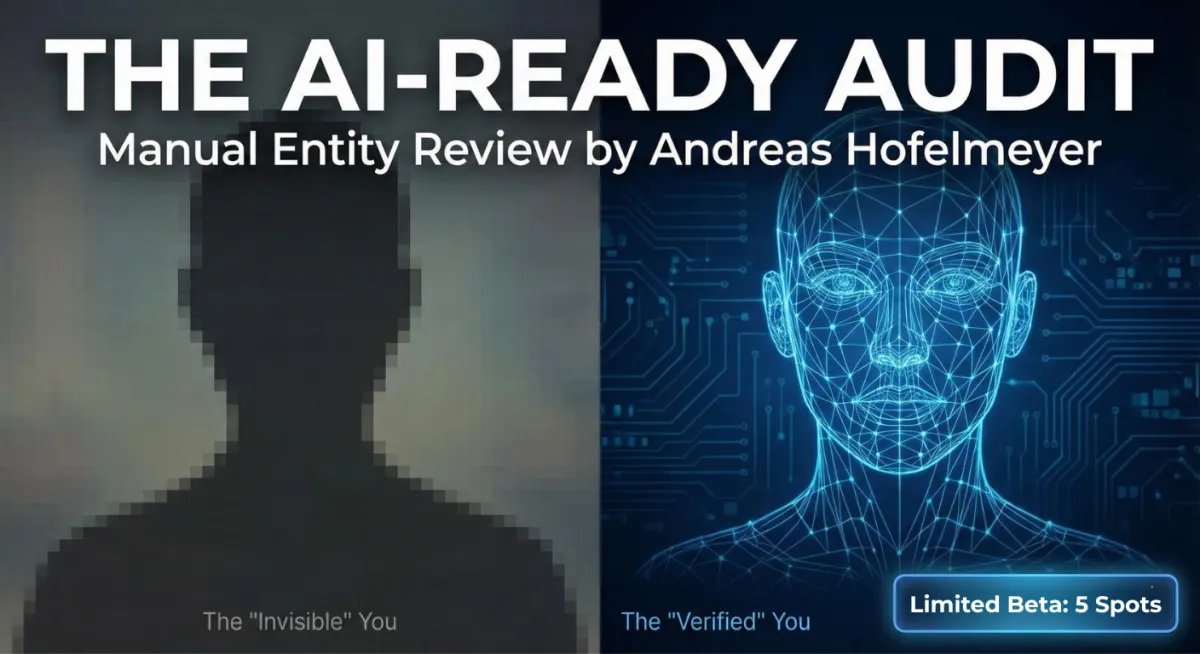
The AI-Ready Audit by AI-fy.me is different. It is not an automated software report; it is a manual review by a Data Architect with 20+ years of experience.
Here is what makes it unique:
Manual Diagnosis: We check the "Gatekeeper Protocol" and "Neuro-Mapping" to see exactly where the AI gets confused.
Source of Truth: We don't just list problems; we provide the code to fix your Knowledge Graph.
Zero Risk: If we cannot identify a critical gap in your visibility, you get a 100% refund.
Most experts are shocked to find that AI recommends their less-experienced competitors simply because those competitors speak "Robot." Don't let your legacy be erased.
Get the AI-Ready Audit for €197.
Secure your position as the authority in your field.

Frequently Asked Questions
How long does an AI readiness assessment typically take?
A standard AI readiness assessment takes 2-6 weeks, depending on organization size and scope. Small businesses often complete it in 2 weeks with focused audits, while enterprises may need 4-6 weeks for comprehensive pillar evaluations.
What is the average cost of a professional AI readiness assessment?
Professional assessments range from $500-$5,000 for small businesses, with boutique LLMO audits at €200-€500. Enterprise-wide services from large firms can exceed $20,000, prioritizing manual reviews over automated tools.
How do you score AI readiness across the key pillars?
Use a 1-5 scale per pillar: 1 (immature) to 5 (optimized). Average scores across leadership, data, technology, capability, governance, and use cases; aim for 3+ overall to proceed with AI projects confidently.
What are common gaps found in AI readiness assessments?
Top gaps include poor data quality (under 80% accuracy), weak governance (no PII controls), and skill shortages (40% of teams lack AI training). Strategy misalignment affects 60% of organizations, per industry benchmarks.
Can you do an AI readiness assessment in-house without experts?
Yes, use free checklists from Gartner or OvalEdge for basics, scoring your pillars in 1-2 days. For accuracy, hire experts as in-house efforts miss 70% of visibility issues in Knowledge Graphs.

